

BDS Observatory provides a fascinating insight into the global adoption curve of intelligent computers powered by artificial intelligence (AI). In this article we explore the predicted trajectory, the priorities of our key partners, the conceptual evolution and the impact of this technological revolution on our business.
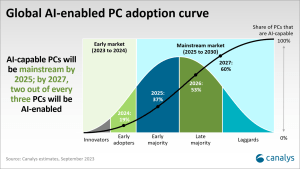
Global adoption curve for AI-powered smart PCs
According to our analysis, intelligent computers with AI capabilities are expected to become the norm by 2025. We estimate that two out of three PCs will be equipped with this technology by 2027. In 2024 we’re already observing a 19% adoption rate of intelligent PCs!
Priorities for our partners
As a market leader and influencer, Microsoft is focusing its strategy on hybrids as an evolutionary model. There are indications that Microsoft is collaborating with PC manufacturers to design products with over 40 TOPS of performance to meet the requirements of the next-gen CoPilot system on Windows, potentially setting a new standard for AI-PCs in the Windows ecosystem.
Lenovo identifies opportunities in excess of €500 million in the field of AI across the EMEA region. With its visionary message “Imagine 2023,” HP is announcing that new PCs will showcase their expanded capabilities thanks to the integration of AI.
Conceptual evolution
Dedicated chips to accelerate AI are currently the norm. In the medium term, NPU (Neural Processing Unit) performance of 10 TOPS is anticipated and in the long term, the generation of text and images with language models of up to 13 billion is envisaged!
What are the potential impacts for Econocom and our sector?
Premiumisation: Advanced hardware specifications and productivity-enhancing capabilities will result in smart PCs being priced 10% to 15% higher than similar commercial models without embedded AI.
Faster renewal cycles: The rapid development of internal and external AI tools coupled with more frequent hardware upgrades will drive organizations to seek out the best experiences for smart PC deployments.
Associated AI services: Smart PCs will act as another point to deliver holistic AI services and solutions, playing a crucial role without mitigating the security and privacy concerns associated with running AI workloads on potentially sensitive enterprise data.