1

Corporate Social Responsibility and digital responsibility: 4 questions to Véronique di Benedetto

As we celebrate the European Sustainable Development Week, we met with Véronique di Benedetto, Vice President France, to discuss our CSR positioning as a Responsible Digital Entrepreneur

This week is going to be full of actions around CSR and responsible digital with the Cyber cleanup week, a new challenge with an ambitious collective objective of reducing our digital environmental footprint by 5% (10M emails) at the group level.

We are committed to CSR. But what does this mean in concrete terms and on a daily basis for our external audiences?

And internally?

At Econocom, we have reduced our carbon footprint by 49.70% over the last three years. Our responsibility takes shape at all levels, here are a few examples:

  • Disability (signing of a new agreement, rate of over 4%)
  • QWL
  • Diversity (diversity charter, women in digital, etc.)
  • Buildings and car fleet


What are our next challenges?

The challenges ahead are huge and we need to accelerate further. For example, we are going to include the impact of our entire business on our carbon footprint. It will be a real challenge to measure and reduce this impact little by little, without affecting our business.

We are also keen to intensify our commitment to the fight against the digital divide and to work closely with many associations working in this area.

There are many exciting projects to come in the months and years ahead!


[SAVE THE DATE] Sustainable Development Week from 20 to 24 September!

As a responsible digital entrepreneur, Econocom is taking part to the European Sustainable Development Week (ESDW). This week will allow us to raise CSR awareness and to provide the means to take concrete action on a daily basis.

On the programme next week:

  • A training session to understand the CSR challenges, the circular economy and digital sobriety.
  • A collection of unused electronic devices (laptops, smartphones, tablets) in partnership with Emmaus Connect and the ARES group will be organised at the Puteaux, Le Plessis Robinson, Grenoble and Villeurbanne sites. The aim of this initiative is to offer employees the opportunity to make a donation and help reduce the digital divide.
  • Advice, ideas, easy actions to implement in your everyday life at the office!

Stay tuned!


Responsible Digital Entrepreneurs: our manifesto

Responsible strategy today enables companies to respond more effectively and appropriately to new environmental and societal challenges and to public expectations. Our customers, partners and employees expect us to provide a concrete response in terms of our impact on the environment and on society when choosing us. This is a decisive criterion. As a pioneer in the digital circular economy, the Econocom Group is committed to publishing the first founding element of our CSR policy: our manifesto.

More with Véronique di Benedetto, Vice President France in charge of CSR ?

Our manifesto 

From the beginning of the school year, new CSR news is on the agenda. You are our best ambassadors! We are therefore counting on you to relay all this news through your networks.

Your CSR contacts :

Véronique di Benedetto: veronique.di.benedetto@econocom.com
Badis Belgacem: badis.belgacem@econocom.com


[REPLAY] Interview with Jean-Louis Bouchard on BFM Business

Jean-Louis Bouchard has been appearing on the french television channel BFM Business. This weekend he has been Frédéric Simottel’s guest in the programme 01 Business.

The french weekly programme 01 Business attracts around 150,000 viewers. It’s all about technological innovation and how it serves businesses.

In the interview, Jean-Louis has promoted the group’s CSR policy and his position as an entrepreneur in responsible digital technology. Econocom is a pioneer in the circular economy of digital technology. This talk presenting the group’s CSR policy aims to help our clients understand the challenges in CSR and to reexplain how CSR is incorporated into our business.

You can watch the programme on the channel’s replay service by clicking here  [Link]

As the replay is only available in French, you will also find in attachment the programme’s transcript translated into English.


Fighting digital exclusion with the Schools Leasing Framework

What if companies were able to take the “farm to table” approach from the food sector to the tech bubble to fight against digital exclusion and e-waste?

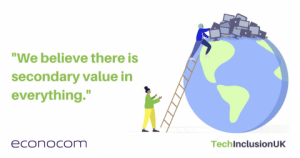
Econocom – an international provider of subscription models for servicing the technology needs of companies, as well as providing the financing and an e-waste plan for them and TechInclusionUK – a new social enterprise enabling digital inclusion – have joined forces to securely wipe and refurbish tech donated by Econocom. Notebooks and tablets have been refurbished to be distributed out to young people in education across Tower Hamlets, through a collaboration with the Tower Hamlets Education Partnership.

Why now?

Shiny and new is great but it is time companies, corporations and their C-suite start taking accountability for their e-waste and energy efficiency. At Econocom, we believe there is secondary value in everything. As the world has gone through a massive change with the pandemic, what becomes clear is that the COVID-19 crisis has shown the effects of the digital divide in the education sector.

Thousands of young people lost a significant amount of contact with school, with those digitally excluded being impacted most unfavourably with little or no access to computer equipment. Students, but also teachers, felt out of the loop due to the lack of sufficient technological resources and digital skills. The most adversely impacted families were those who suffered from a loss of income and in turn struggled to support their children with the new normal of home online learning. At Econocom, we think it’s possible to bridge the global digital divide if we promote innovative ways of doing business and this great partnership is one way of achieving this.


How the circular economy can help businesses become sustainable

As society becomes more mindful of the effect it has on the environment and takes steps to lessen this impact, we are beginning to see the business world follow suit. While the majority of organisations have traditionally relied on a linear business model, it has become clear that this way of operating follows a pattern of ‘take-make-waste’. Consequently, an increasing number of enterprises are beginning to explore the circular economy in order to become more sustainable. Underpinned by a transition to renewable energy sources, the circular economy seeks to redefine growth and focus on positive society-wide benefits.

Through a shift in perspective, businesses have the power to re-design the way our economy works by designing products that can be ‘made to be made again’ – powering the system with renewable energy and changing the way we make, buy and consume goods.

Four essential building blocks – how businesses can embrace the circular economy

Embracing a circular economy mindset is about keeping resources and assets for as long as possible, extracting the maximum value from them, favouring access to services over ownership and regenerating materials to create further value. As such, it’s not a sector-specific approach: the circular economy is something that every business can adopt. And the benefits of such a system are undeniable. Research undertaken by the Ellen MacArthur Foundation, a pioneer in circular methodology, predicts that widespread adoption of circular principles could see a 48% reduction in carbon dioxide emissions by 2030.

When it comes to business implementation, the circular economy centres around four essential building blocks: design (material selection, products that are designed to last and easy end-of-life sorting), new business modelsreverse cycles (return materials to the soil or put them back into the industrial production system) and enablers (policy makers, educational and financing). By building these core competencies into their design strategy, companies can pave the way to a more sustainable future – innovating their business strategies to facilitate product reuse, capitalise on new opportunities, develop new skills in delivery chain logistics, and work with enablers to lead by example in improving resource productivity.

In essence, embracing a business-focused circular approach is a simple case of re-assigning assets to create further value. The plastic sustainability initiative launched by plastic recycling facility Continuum at the London 2012 Olympics is one such example. Plastic bottles were produced with high levels of renewable content, such as plant-based PET, making it easy to recycle them into new bottles. As a result, 15 million bottles were collected at the Olympic and Paralympic Games and returned to the shelves as new bottles within six weeks.

Circular financing models

As-a-service or subscription models – as opposed to traditional ownership – act as the access point for businesses wanting to join the circular economy. Such models allow organisations to fund circular economy projects without the burden of large upfront investment. Not only do they include lifecycle services, but they can also balance the investment by relieving the burden on capex while delivering on the business’ objectives. This then frees up the company from the burden of diverting funds from other services to remain operational and agile. Additionally, when the as-a-service contract expires, the equipment will be collected, recycled and wiped as part of the subscription in order to close the loop and create further value. Favouring access over ownership is key to embrace a circular economy mindset.

Going beyond the ‘green’ – non-environmental business benefits of joining the circular economy

When it comes to business success, key drivers centre around financial gain and future viability. By using a circular economy approach in an organisation, not only can businesses reduce their carbon footprint, but they can capitalise on the value of their resources to save money, improve performance and build new relationships. A more eco-friendly approach can help businesses stay ahead of the curve when it comes to government legislations; allowing them to keep pace with new requirements and exceed industry standards.

Revolutionising company strategy through material re-use is the first step in establishing a brand as an innovative organisation. Circular companies have a reputation for being positive disruptors in the market; and as such, have a huge advantage when it comes to attracting talent and engaging employees. Above all, by adopting a circular approach, companies can migrate from the ‘take-make-waste’ mindset and create sustainability for the future – both for the environment and for their own ongoing viability.