1

First edition of the Group TMF Sales Academy

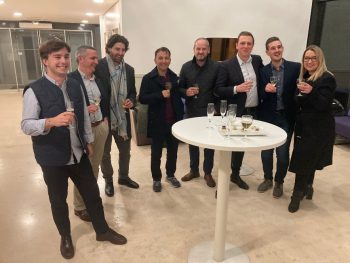
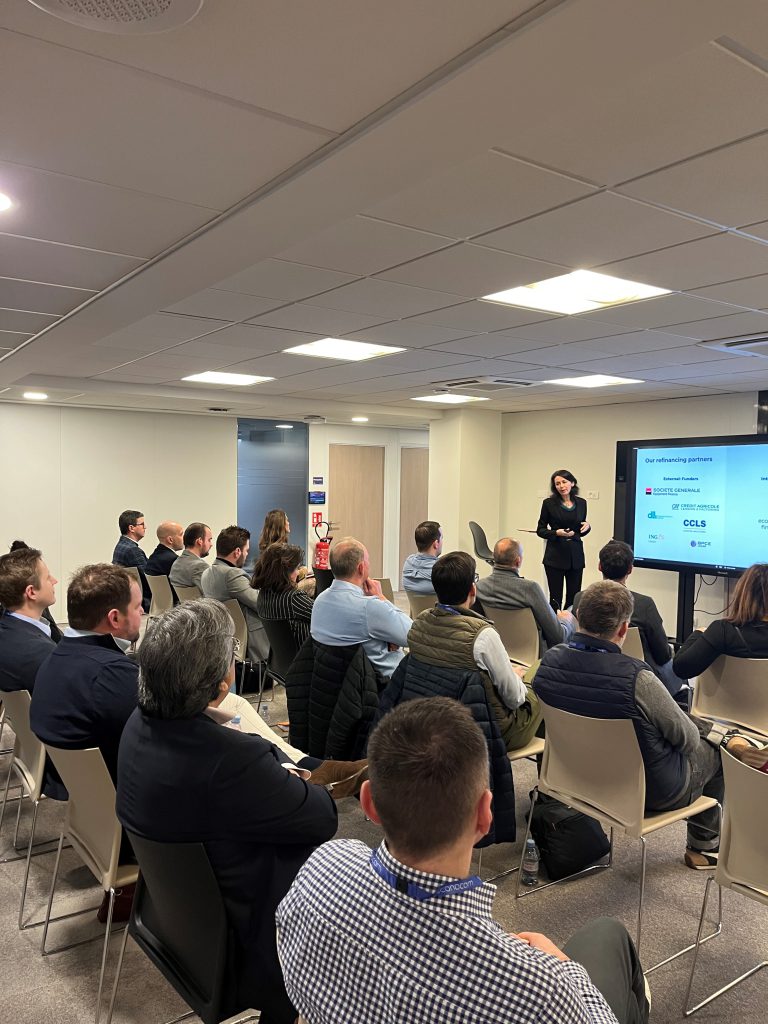
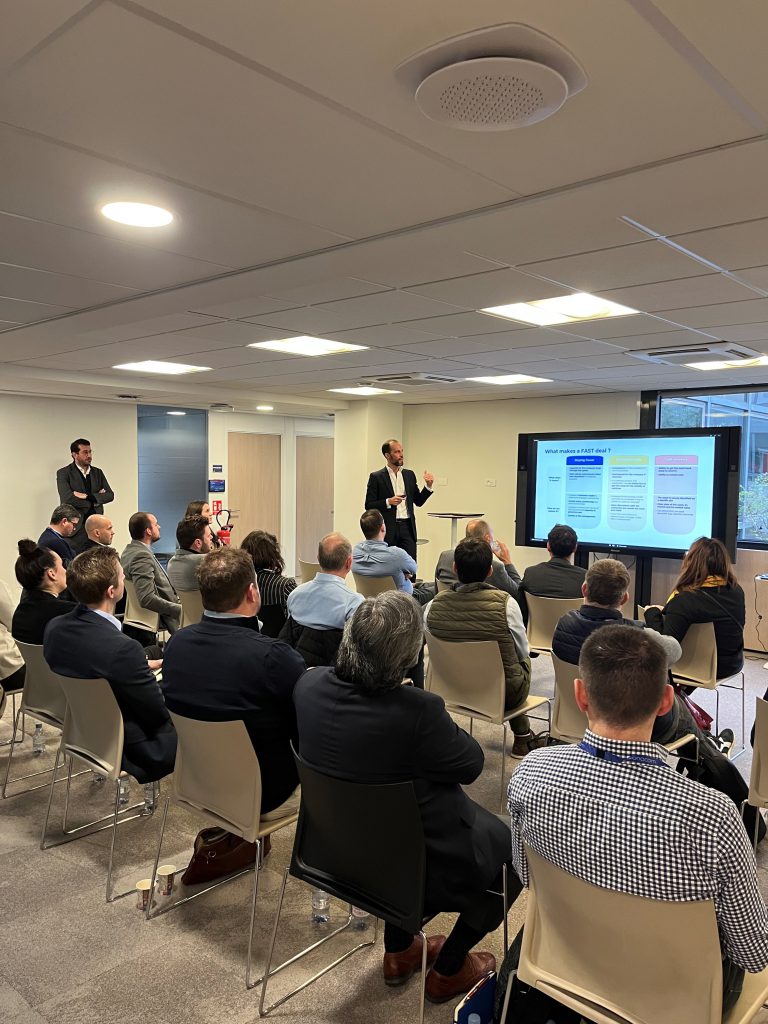
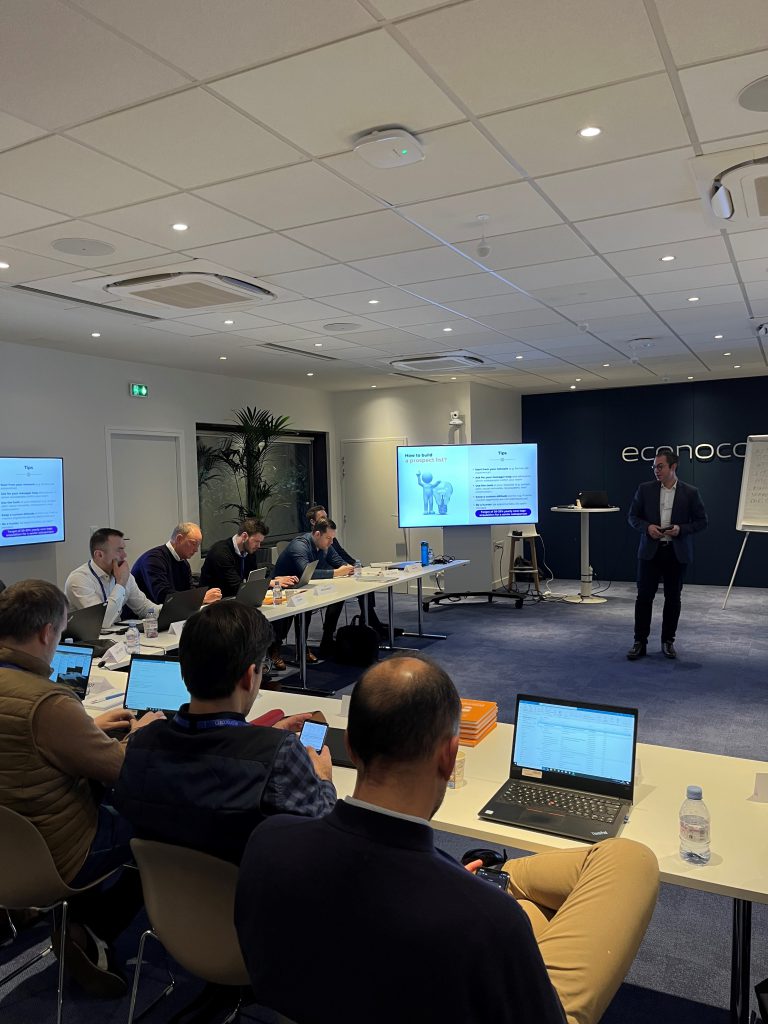
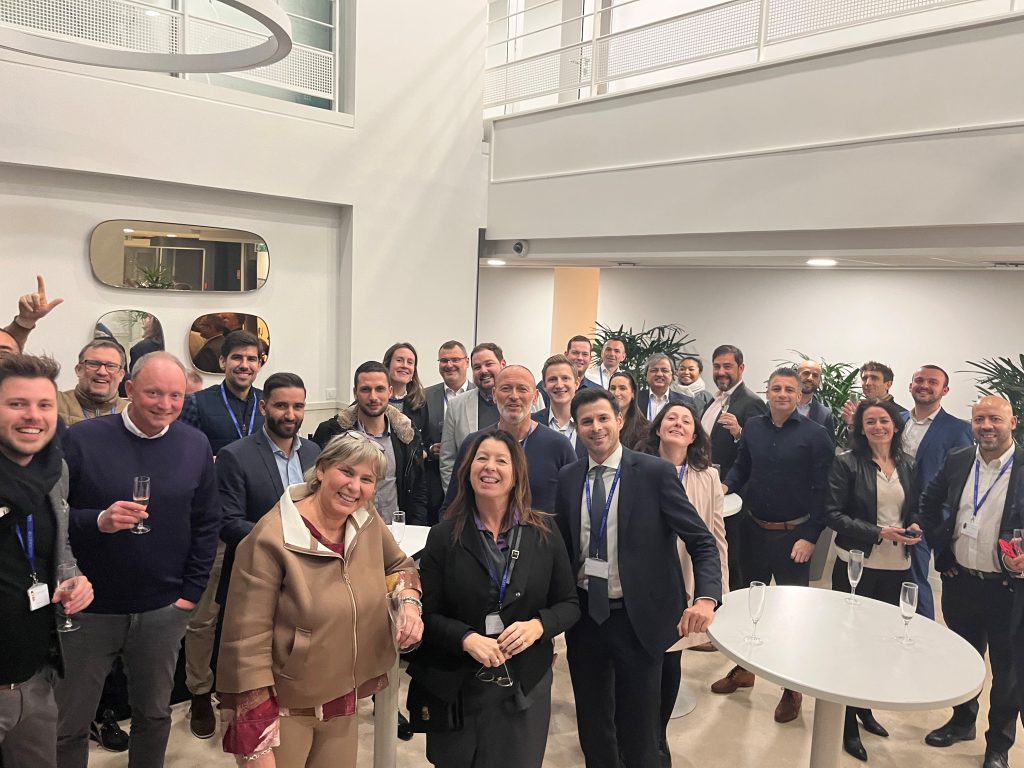
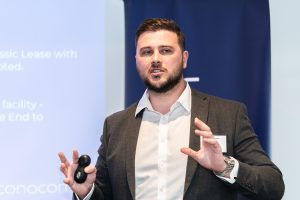
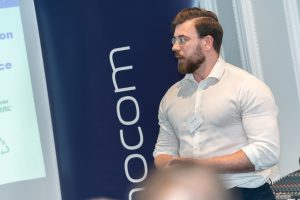
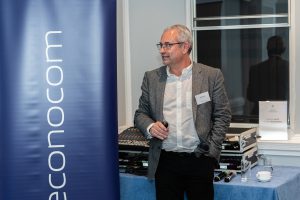
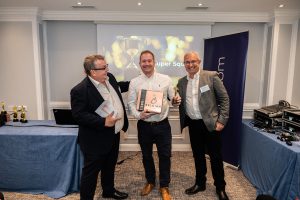
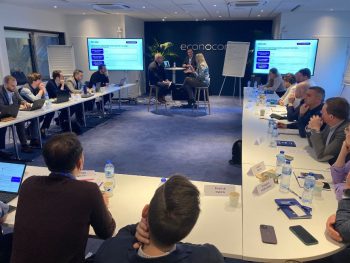
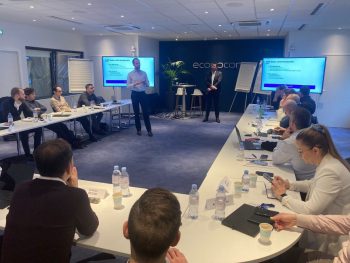
We were proud to hold the first edition of the Group TMF Sales Academy in Puteaux from January 29th to February 1st.

This event was the opportunity to gather no less than 22 TMF sales from 6 countries (mostly recent joiners) to develop their skills, make them discover Econocom Group and grow their internal network.

Sandrine Fievet, TMF training manager in charge of the French Sales Academy since 2014, explains: “designed as an immersive and tailored learning scheme, the Academy consists in several seminars aiming to provide a comprehensive knowledge of the TMF business. For this first 4-days seminar, the newcomers receive intensive trainings, presentations and best practices on sales skills (e.g. prospection, selling technics) from experienced trainers across different Group functions.”

“As one of the main levers of our strategic plan is to massively recruit salespeople, we are convinced that their onboarding is crucial to achieve our ambitions” comments Pâquerette de Poncins, BDS senior manager and ESA co-organizer.

The organizing team would like to thank Patrick Van Den Berg, Mathilde Saint-Pol, Christoph Blaeser, Philippe Hemmings, Jaroslaw Schwinge, Elzbieta Manjurka, Amine Belfakir, Antonella Porta, Luca Nanni, Guillaume Steible, Nicolas de Lepinay, Pierre Toussaint, Lionel Slama and Stéphane Pailler for their interventions and exchanges with the audience.

We would like also to thank all the attendees for their active involvement and look forward to seeing them again for the next steps of their training program.  

A dedicated post has been published on Econocom Group LinkedIn account, please do not hesitate to comment and share.

We invite you to respect the privacy and not to publish on social networks photos of other people without their prior consent.


First edition of the International TMF Sales Academy

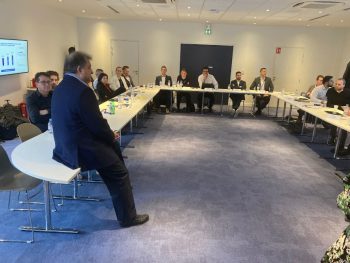
We were proud to hold the first edition of the International TMF Sales Academy in Puteaux from January 23rd to January 26th.

This event was the opportunity to gather no less than 19 TMF sales from 7 countries (all recent joiners) to develop their skills, make them discover Econocom Group and grow their internal network.

Designed as an immersive and tailored learning scheme, the Academy consists in several seminars aiming to provide a comprehensive knowledge of the TMF business.

For this first 4-days seminar, they received intensive trainings, presentations and best practices on sales skills (e.g. prospection, selling technics) from experienced trainers across different Group functions.

The organizing team would like to thank Angel Benguigui, Mathilde Saint-Pol, Christoph Blaeser, Guillaume Steible, Sebastien Lesimple, Amine Belfakir, Antonella Porta, Pierre Toussaint, Lionel Slama and Stéphane Pailler for their interventions and exchanges with the audience.  

We would like also to thank all the attendees for their active involvement and look forward to see them again for the next steps of their training program.  

A dedicated post has been published today on Econocom Group LinkedIn account, please do not hesitate to comment and share!


We invite you to respect the privacy and not to publish on social networks photos of other people without their prior consent.


Econocom wins the OJEU tender for the Schools Leasing Framework for the 3rd time!

For the third time in a row, Econocom was awarded the Schools Leasing Framework following the comprehensive Find a Tender Service procedure*.

With an existing and positive reputation in the market and a strong understanding of schools’ needs, Econocom becomes once again the authorised provider for the framework.

The Schools Leasing Framework is fully compliant with current leasing rules and will remain compliant when IFRS 16 is adopted by schools. It is also the Department for Education recommended solution for financing UK schools’ technology investment and staying up to date with digital advancements.

Want to learn more? Visit our dedicated page.


* OJEU framework award notice reference no. 2022/S 000-015352


London Kickoff with Angel Benguigui

Last Tuesday, our Econocom UK & IRL, Econocom US & CAN and Trams l Econocom teams met for our first joint annual kick-off event in London. We were joined by members of Group including our Group Executive Managing Director; Angel Benguigui.

Attendees were given by Angel Benguigui an insight into Group’s strategic plans for the future, financials and shared client success stories.

The meeting was followed by an awards ceremony to recognise our dedicated employees’ hard work and the evening finished with a light-hearted singing contest allowing the teams to demonstrate their vocal talent… or lack of!


Econocom announces the acquisition of SOFI Group

Econocom announces the acquisition, via TMF France, of SOFI Group, a leading industrial player in France’s digital refurbishment market, with a view to breaking into the European refurbishment market.


Econocom, Europe’s leading global digital services company, announces the acquisition of a majority stake in SOFI Group, an industrial leader in “made-in-France” refurbishment of smartphones and tablets. The acquisition, conducted by the TMF (Technology Management & Financing) division, an independent leader in the financing of digital assets in France, fits into a shared strategy to conquer the digital refurbishment market in Europe.


Based in Saint-Mathieu-de-Tréviers near Montpellier (34), SOFI Group is a French specialist in refurbishing locally sourced multi-brand smartphones and tablets. A leading industrial group in its sector, SOFI Group is best known to the public through its SMAAART brand launched in 2017, which offers second-hand smartphones and tablets refurbished at the Group’s own factory in Saint-Mathieu-de-Tréviers. As a leading circular economy operator, the Group has been a société à mission (mission-led company) since October 2021.


This deal has been struck against the backdrop of a fast-growing market for refurbished smartphones in France (up 10% in 2020) and a steadily expanding global refurbishment market estimated at over €50 billion in 2020. In France, this growth is partly due to the enactment of the AGEC[1] Law and, more generally, to the aspirations of citizens and organisations seeking cheaper and more eco-friendly IT devices.

The acquisition allows Econocom, the leading independent funder of digital assets through its TMF division, to address this growing market and expand its positioning throughout the life cycle of fixed and mobile IT equipment. SOFI Group’s industrial plant and technical expertise is a way for TMF to bring in-house and significantly expand the volumes of hardware refurbished to meet growing demand for such devices among public and private organisations alike.

Econocom already processes 200,000 assets annually in France and integrating these volumes will boost SOFI Group’s development, particularly in its SMAAART brand. The Montpellier-based business will also benefit from the financial backing of Econocom, which has an ambitious strategy for growing its refurbishment business both in France and abroad.

Samira Draoua, CEO of TMF, explains: “We are delighted to welcome SOFI group and all its employees to Econocom. Econocom’s financing business, led by TMF, is pioneering the development of product ranges that have a positive environmental impact. This deal will strengthen this market leadership by giving TMF a cutting-edge industrial plant and unique French know-how. This means we can add to the value of our environmentally responsible range across the European market.” 

Jean-Christophe Estoudre, Chairman and co-founder of SOFI Group and Marlène Taurines, CEO and co-founder, said: “We are proud to see SOFI Group join Econocom, a group that shares our values, particularly on social and environmental responsibility. This transaction marks a new phase in our company’s development: backing from Econocom, a European-scale group specialising in digital technology and transformation, will allow us to scale up our operations over the coming years.” 

[1] The AGEC Law (law against waste and for the circular economy) requires all public sector IT procurement contracts to include a “re-use” lot.


Econocom welcomes new TMF salespersons and praises its top performers

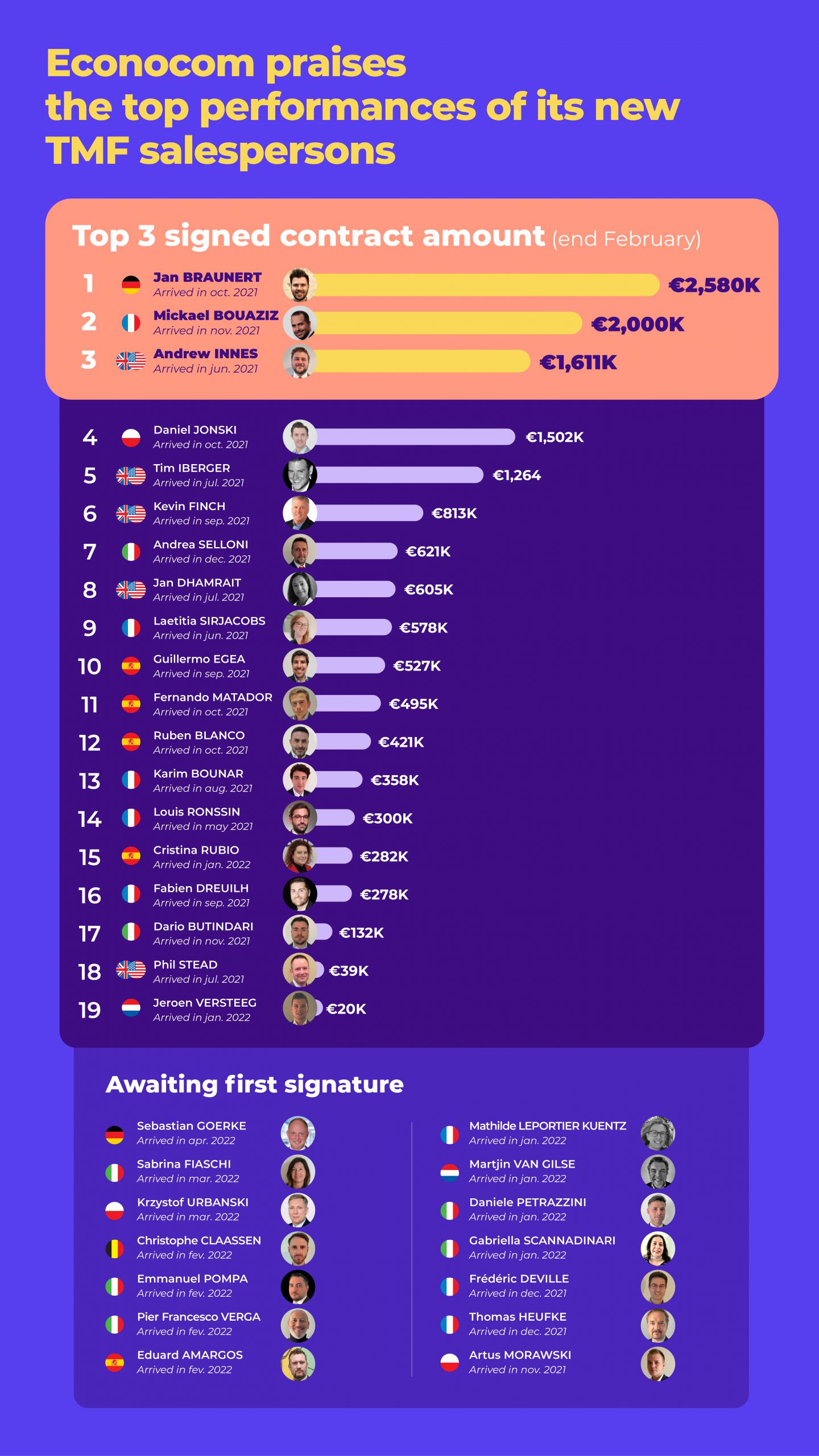
In May 2021, Econocom set the target of recruiting thirty new salespersons for TMF business across its locations. Today, we are pleased to announce that this net recruitment target is 85% met. Econocom welcomes its new joiners and congratulates Jan Braunert, Mickael Bouaziz and Andrew Innes in particular for their performances since joining us.

The plan, launched in May 2021, forms part of the development ambitions for TMF business in 2022. The recruitment of new talents is set to play an essential role in our growth strategy. Thirty additional salespersons are to be recruited in all TMF locations (France, Italy, Spain, Benelux, UK/US, Germany and Poland), representing a +25% increase in the workforce vs. May 2021. To date, three locations have achieved their objectives and the recruitment target is 85% met.

Out of these new joiners, three are already notable for their performances. First, Jan Braunert, a senior salesperson who joined TMF Germany in October 2021, has signed two contracts with a total value of nearly €2.6 m. Mickael Bouaziz, a TMF senior salesperson, has secured signatures worth €2 m. Finally, junior salesperson Andrew Innes, who joined us in the UK in June 2021, has signed several contracts to his name with a value of over €1.6 m. These results will be updated monthly: stay connected to find out who will be on the podium next!


Embracing the hybrid workplace

We are entering a new era of work. The recent switch to remote working has forced us to reinvent the way we work when face-to-face meetings are no longer possible. According to ITProPortal, 1.7 million people in the UK worked from home before Covid, but due to lockdown restrictions, an estimated 20 million people have had to relocate to home offices.

Organisations are now thinking about how to move forward, and looking at both flexible work arrangements as well as ensuring a safe return to the office. Despite the challenges, we now have the unique opportunity to fundamentally improve the way people work, wherever they are.

So, what is the workplace of the future going to look like? How will employee experience change? What will success look like for those embarking on the journey of transforming the workplace?

As with most things in life, there is no one size that fits all. Different work environments have different needs. Manufacturers, retail shops and schools each have their own ways of communicating, dealing with customers, and generating business value. They each face different pressures today and they’re each going to react differently to changes in the future.

What ties them all together is an increasing reliance on digital technology to keep employees safe and maintain productivity.

The pros and cons of remote working

According to a recent survey from BCG, 86% of UK employees working remotely have experienced a positive impact on their work. Among the top 5 positive impacts, 59% said they enjoy having reduced commute time. This was followed by more flexibility on working hours (45%), feeling safe due to social distancing / hygiene protocols (39%), increased control and autonomy (19%), and decreased distractions (18%).

But real challenges still need to be addressed. The same survey reports that 79% of UK employees experienced at least one negative impact on their work. 30% said they experienced blurred boundaries between work and home life while 29% felt more distracted at home. 22% also suffered from inadequate work space at home, anxiety and depression or feelings of loneliness.

Overall, 75% of employees have been able to maintain or improve productivity on their individual tasks vs. 55% on collaborative tasks.

Ensuring connectivity to your mobile workforce

Remote staff often work from different places and heavily rely on mobile devices and laptops. By making mobility a key part of your workflow strategy, you enable efficiency and offer more flexibility.

With BOS, our mobile-as-a-service solution, you can equip your employees with the latest devices in no time, while benefitting from end-to-end services. Deploying mobile technology with a subscription-based model will help you make savings and keep your employees engaged, connected and secure through Covid and beyond.

Creating smart workplaces

Providing remote workers with the right technology and ensuring a safe return to the office is critical to business continuity. Companies that will survive are those that think strategically and have a long-term vision for the future of work. With Econocom, you can easily reorganise your office on a regular basis and implement intelligent workplace solutions, all through a simple subscription plan.

From mobile devices to office fitout, we help you accelerate your digital transformation to preserve staff safety and enhance productivity. This ensures that as your business evolves, your workspace does as well.

What the future holds

Remote work software, like mobile work tools and virtual reality conferencing, should become the preferred form of communication – even over face-to-face meetings. Artificial Intelligence (AI) is also likely to play a major role in managing remote staff.

These advancements might put companies more at ease. The transition to managing a remote workforce might be daunting, but with the right tech and our support, it can be a seamless process.

The BCG survey reports that 67% of UK employees who worked remotely since Covid believe a hybrid model of remote and in-workplace work is ideal for them and their colleagues. This kind of model allows for the benefits of working from home plus the human connection, in-person relationship building, and increased visibility enjoyed in the workplace.

Instead of resisting the change, companies should improve their remote work policies and capabilities by going digital. If you’re looking for ways to engage and protect employees while preserving your cashflow, our Econocom team will be happy to help you.
TCO: How to calculate the Total Cost of Ownership to optimise your investments

What if the price you pay for your equipment is not what it really costs you?

Behind this mysterious question lies the concept of Total Cost of Ownership.
In basic terms, this means that there are significant hidden costs that are part of the life cycle of any equipment, from solar panels to self-checkout. The costs for maintenance, upgrades, training, repairs, security, insurance etc can have a considerable impact on your budget, as they are often underestimated at the time of purchase and exceeded in the long term.

“The TCO concept is like the submerged part of the iceberg: 90% of the giant block of ice is invisible to the eye because it is located underwater.”

Buying will always be more interesting than renting. Or will it?

This preconceived idea comes from the real estate world. But what is generally true for buying real estate, doesn’t apply to equipment depreciating in value over time such as IT, cars or professional equipment. For these assets, renting is the right choice.

With an as-a-service model, the management of hidden costs is transferred to a third party. This is not only an important financial advantage, but also an added value in organisational terms. It is not the core business of companies to maintain IT or to upgrade tech equipment.

It is possible to save 20 to 30% of the total amount by integrating the complete life cycle of the asset. Via an as-a-service model, you save costs by not having to deal with recycling and data wiping and you always have up to date tech. In case of breakdown or outdated equipment, you receive a replacement device right away and don’t have to support heavy maintenance costs.

TCO makes you aware of hidden costs

  • Time spent negotiating the purchase
  • Administrative follow-ups
  • Hardware installation
  • Productive time lost by users (during installation and afterwards, given the new work habits to be put in place)
  • Equipment maintenance
  • Network maintenance
  • Updating and securing
  • Inactivity of an employee in case of breakdown
  • Cost of computer support
  • Management of obsolescence and resale (or replacement)

Gartner estimates that the TCO of a PC purchased at £660 ranges from £1,940 to £3,180 per year. The question of value is therefore central.

Switching to as-a-service models allows companies to reduce costs and have the right flexibility when business increases or decreases. A leaner organisation becomes more agile and keeps its cash for core activities.

With a TCO under control, you optimise your budget

The number of buyers looking for as-a-service models is constantly increasing, in order to benefit from the following:

  • no risk of failure or obsolescence,
  • everything is integrated and included,
  • no bad surprises putting a strain on the budget
  • financial visibility is increased and costs are reduced

A controlled TCO is also a way to support companies in their digital transformation.
A subscription model helps avoid unnecessary or inefficient purchases thanks to controlled financial planning, greater productivity and the latest hardware and software.

Taking the time to question the TCO means taking the necessary action to optimise your development strategy. It is difficult to anticipate the future when your assets prevent you from taking off. By calculating the TCO for each of your fixed assets, you can have an overall view of the future room for manoeuvre available to you.

To reduce your TCO, an as-a-service model is the ideal solution for all organisations.


How companies are shifting their IT investments

COVID-19 has been the greatest challenge the world has seen in decades, resulting in a dramatic acceleration in the need for digital transformation. Companies had to react quickly and switch to remote working, without all the necessary capital and human resources in place.

Unforeseen investments, including laptops, apps, cloud computing and security, have had to be generated. Due to declining revenues, fixed costs and deferred payments from customers, lack of cash has become a big problem.

In light of the cost pressure due to uncertain business and economic conditions, more and more companies are opting for “as-a-service” models and moving to OPEX for their IT investments.

Immediate need for digital transformation since the pandemic

To strive in this economic downturn, companies were forced to fast-track their digital transformation efforts. A survey by Gartner in September 2020 found that 69% of the board of directors accelerated their digital business initiatives.

Technology driven companies have been leading the path to a faster recovery.

To meet employees’ needs and customers’ demands, IT and Procurement leaders should continue transforming their operating models and investing in key enablers, such as cloud computing, intelligent automation, artificial intelligence, blockchain, and advanced data and analytics.

recent report from IBM shows that 36% of business executives now assign high or very high priority to digital transformation compared to 17% in 2018. In 2022, this percentage is predicted to reach 62%. Another study by Nasscom, reports that more than 70% of CIOs are prioritising digital spend and moving to OPEX. In 2005, IT expenditure was 34% CAPEX vs 66% OPEX compared to 24 vs 76% in 2019-2020.

Cash is king and the emergence of as-a-service models

Having a favourable cash flow is particularly important in times of economic decline, when credit is harder to obtain. If a business can continue to ensure the regular inflow of liquid capital whilst controlling costs, it will be much better placed to ride out the storm of lower sales. In this context, the Device-as-a Service (DaaS) model of acquiring hardware by paying rental payments over time to preserve cash reserves is gaining significant traction in the technology sector.

Below are the main advantages given by the DaaS model:

  • Companies shift large IT budget allocations to more manageable expenditures over a planned period of time. It reduces the Total Cost of Ownership (TCO), allowing business leaders to make more strategic decisions regarding future investments.
  • Obsolescence risk is removed. Some goods require regular maintenance or even replacement. This is particularly the case for hardware. With an as-a-service contract, you avoid the risk of obsolescence and the problems of disposal of the equipment.
  • Setting up an as-a-service contract means benefiting from a complete, fully customisable service, with optional add-ons: upgrades, technical support, data wiping, recycling etc. Each contract is adapted to your activity and your company’s needs.
  • It increases flexibility: Unlike traditional IT infrastructures, the DaaS model allows organisations to ramp the number of devices up or down as required. At the end of the as-a-service contract, companies have three options: extend the subscription, return assets and renew the contract with upgraded tech or purchase the assets.
  • The DaaS model promotes multiple device models and configurations, enriching employees’ productivity and experience.

In 2015, according to TechRepublic, no major PC manufacturers were offering DaaS options to their customers, compared to 65% now.

Most companies also opt for subscription-based models to better meet customers’ expectations. The flexibility offered by as-a-service models means consumers pay for things as and when required, with some accessing goods or services they wouldn’t otherwise be able to afford. And with the transition from ownership to ‘access’ comes the opportunity to build a circular economy by innovating and saving costs and energy while conserving natural resources and reducing e-waste.

New business priorities

With all this happening around us, how much have long term business priorities really changed?

Asked about the most pressing of these priorities, C-suite executives ranked “workforce safety and security” number one, closely followed by “crisis management”, “cost management” and “cash flow management” (IBM reports).

Most companies are now switching to OPEX models to better manage their costs and optimise their cashflow.

In times of crisis, cash is king. But the current environment presents a big opportunity for digital innovation, and business survival will mostly depend on strategic IT investments.
To help navigate the tension between financial cuts and critical investments, shifting from CAPEX to OPEX could be a good alternative; it frees up funds that organisations can allocate to core business activities.