
As part of their digital transformation initiatives, nearly 70% of companies plan to renew their IT infrastructure in the next two years, whilst demand for flexible consumption models is soaring, according to IDC (International Data Corporation) forecasts. The importance of aligning IT transformation with business strategy has become increasingly obvious as no company can thrive digitally without a solid technological foundation. This fascinating subject was discussed at a dedicated roundtable at Milan’s Phyd Hub on Thursday 6 July.
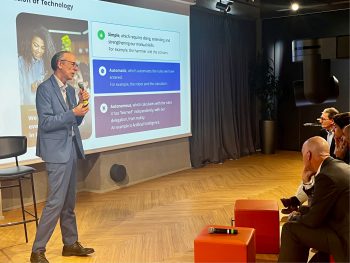
« Econocom|Asystel Bizmatica has the necessary expertise to support clients in developing and implementing innovative DC/Cloud projects, such as defining new, secure by design data centres and infrastructures, but also the organizational structure of hybrid IT operations that can manage all the potential problems, changes and workaround solutions, with an approach based on KPIs and SLAs and focused on automation, multi-level surveillance and observability. Those factors are essential to provide the flexibility needed to adopt the as-a-service model, such as Lenovo TruScale, and the efficiency needed to identify potential problems, » says Ferruccio Radici, DC/Cloud Infrastructure Solutions & IT Services BU Director with Econocom|Asystel Bizmatica.
The IT infrastructure is one of the essential pillars of digital transformation (DX). No digital initiative can succeed without an IT transformation aligned with business strategy. The commercial requirements that make the digital transformation necessary play a crucial role in these transformation efforts, and their influence now extends to numerous fields within companies: business affairs, information technologies and finance.
Decision-makers increasingly involved
Decision-makers are increasingly involved in reaching strategic decisions on the digital infrastructure or overseeing those choices. Chief Information Officers (CIO) manage the partnership with the business lines and ensure the achievement of business results and alignment with the company’s key performance indicators. Chief Financial Officers (CFO) meanwhile are playing a more and more important role in the decision to adopt flexible consumption models for the supply and optimization of digital infrastructures.
« When I flick the switch, I 100% expect the light to come on, but I’m not interested in the mechanisms that make that possible. At the same time, clients are demanding systems that are always operational, reflecting changes in the use of IT, which has to move away from operational activities and concentrate on essential company-focused activities via a partner that can provide the system and specialized operating services, » Ferruccio Radici explains.
The broader aim is to align technological spending and use of the digital infrastructure’s resources with achieving priority business results, particularly operational resilience and agility, cost management, innovation, increased client and partner engagement plus a better user experience.
The boom in as-a-service
By 2026, IDC predicts that 65% of technology buyers will prioritize as-a-service models, triggering growing demand for flexible consumption models in different environments, such as the public cloud, onsite infrastructures and edge computing.
Paying only for the IT resources actually used, e.g. with onsite pay-per-use models, is now essential to support the development of digital activities. However, that isn’t the only factor. Automation and full coverage of the infrastructure stack, including both centralized and edge computing, are playing a crucial role in the growth and success of digital companies. By harnessing these elements in synergy, organizations can optimize their efficiency, increase their agility and, all in all, seize the opportunities offered by the digital economy more effectively.