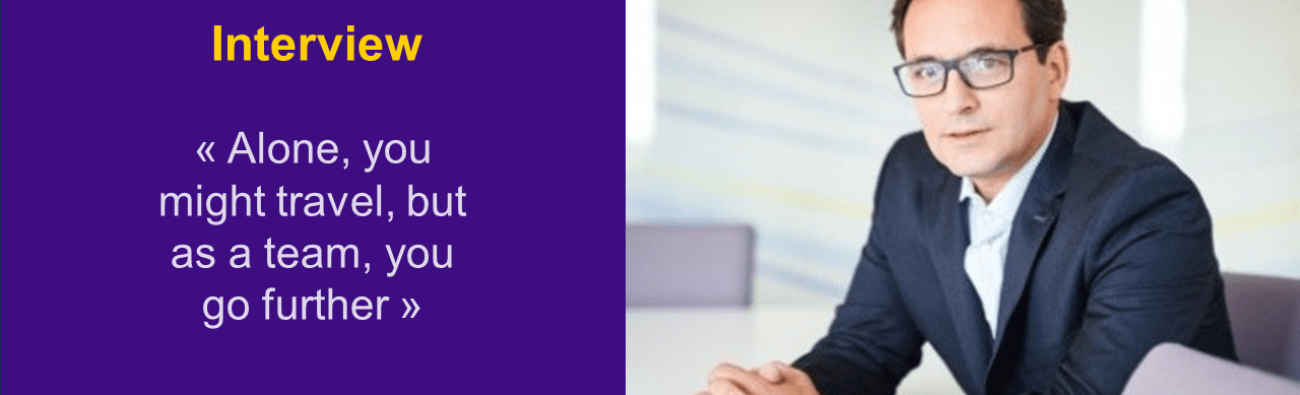
Trained as an engineer and a father of two, Olivier Berrouiguet is CEO of Synertrade, a subsidiary of the Econocom group specializing in digital Source-to-Pay solutions (the purchasing-finance process). With 400,000 users, the company continues to gain market share, with sales of €16.7 million generated in 2022 and a target of €23.4 million this year. As a company turnaround and restructuring specialist Olivier Berrouiguet was instrumental in this success. Let’s meet him.
Could you briefly describe your academic and professional career?
O.B : I’m 53 years old and trained as an engineer (editor’s note: he is a graduate of the Ecole Universitaire d’Ingénieurs de Lille and has a Master in Business Unit Administration from HEC). I quickly opted for a career in business development and sales, initially with Merck. I’ve always been attracted by the idea of living in different countries: I grew up in Switzerland, in the South-West of France and in Greece. I love hobnobbing with people from diverse cultures. And at Merck, I had the opportunity of working in some 20 countries in Europe, Asia and the United States.
What was your first experience in financial turnaround?
O.B: My first management experience was with a team of fourteen people when I got involved in a turnaround project at Taylor Hobson. The plan, which aimed to make the company more profitable, panned out. I first worked on the collective dynamics of a team that had experienced failures, and it was, then, that I learned the adage: « Alone, you might travel faster, but as a team, you go farther» ». Because managing means delegating, trusting others and accepting the mistakes we’ll be making together. Five years later, the company was acquired by the Ametek group. Then, in 2006, I joined Sensitive Objects, a start-up specializing in touchscreens, as Sales Director. And I witnessed the start-up’s first successes, from the copying of our patent by an American company to its sale.
« Managing involves delegating, trusting people and accepting the mistakes
we will be making together»
Thereafter, you joined Capgemini back in 2009. In the IT division or in advisory work?
O.B: In the IT division where I was Global Account Manager of the Sanofi account for Capgemini. I had a penchant for pharmaceuticals due to my time spent at Merck, and focused on reconciling business needs with Sanofi’s IT reality. This account had long been neglected. And at the end of the day, with a team of 5 people, we grew sales from € 3 million in 2008 to € 40 millions in 2012.
In 2017, you established your own company, My Cube, what was the motivation behind this?
O.B: Just before embarking upon my entrepreneurial experience, I had joined Voluntis for 5 years; it was exciting to be Sales Director of a medical software publishing company. I clinched the best deal in my whole career a multi-million contract on the basis of 2 slides that summarized the added value created by our solution. And in 2017 I created My Cube, drawing on my experience in digital health to offer my customers services in selling and defining their targets.
You went it alone in this entrepreneurial endeavor
O.B.: Absolutely, I almost went into partnership, but the person who was going to join me ended up taking a full-time job.
And what made you want to join in 2018?
O.B: Team adventure! I wanted to work with teams again, and a former Capgemini employee, Laurent Roudil, convinced me at the time to join Econocom. I was appointed Director of Strategic Accounts; then moved on to become Director of Strategic Deals. Econocom also gave me the leeway to manage a global entrepreneurial project: with Synertrade, beginning in the summer of 2021, I have taken over the corporate mandate for six companies (in France, Germany, Italy, Luxembourg, the USA, Romania and Spain).
« A turnaround plan that now delivers profitable growth »
When you became head of Synertrade, what were your goals?
O.B: When I took over, we had issues with team rotation and a power vacuum: my goals were to write the score, i.e. our 3-year turnaround plan. We had to reorganize and even turn around the company, which specializes in procurement software suites, with the added challenge of understanding and controlling suppliers.
How many employees does Synertrade have? How have sales fared since you took over?
O.B: We employ 150 people. We have increased our sales from €12 million in 2021 to 16.7 million in 2022, but we are still in the red. In 2023, we’re aiming for 23.4 million – I hope we’ll best that figure! We’ve broken a negative cash flow cycle thanks to a turnaround plan that is now delivering profitable growth. In particular, in 2022, we were back in Gartner’s Magic Quadrant ranking and came out top in Quadrant Matrix 2023 solutions SRM ( Supplier Risk Management), a result which makes me very proud, and we’re going to be high up in the rankings in 2023.
Great show! What is your take on the situation of the market you are operating in?
O.B: The e-procurement market is worth € 7 billion worldwide, half of this being generated in the United States and one third in Europe. The market’s growth is being driven by the United States where growth is projected to reach 20% annually over the next 3 years, and also by the increasing number of global risks that are having an adverse impact on procurement: We can cite in this regard inflationary pressures, of course, shortages and stockouts of raw or semi-finished products, and regional risks as well as disruptions in supply chains that are a powerful driver of growth: for instance, sourcing certain components from China is going to be more challenging, since the USA banned the import of Huawei devices… In Europe, The fact that CSR issues are increasingly coming to the fore will provide great opportunities pour leading companies like ours that supply SRM solutions. In June, we were awarded a contract for the management of supplier risks by the Auchan Group against all our European and American competitors: This is a source of great pride for the whole team and an earnest of future successes!!
What kind of manager are you?
O.B: I am trying to be the conductor who both writes and plays the score, and expects very good execution from the teams. One should never lose sight of the fact that 95% of value derives from flawless execution. You excel when you’re very good at innovation and very
skilful at execution. I’m in favor of a culture of flexibility rooted in results. The teams were very happy to celebrate our performance last year, and I’m very proud of that.
« 95 % of value stems from proper execution »
What are the driving forces behind that success?
O.B: I believe that we were not in control of our product, and therefore not in control of our destiny. We acted like a service company, whereas we are basically a product-driven company – products that include embedded intelligence and know-how. We have regained control of our strategic and financial destiny thanks to our turnaround plan, with a product that we control thanks to a clear vision of our added value in terms of procurement risk management and supply chain issues.
A final question: do you have any hobbies?
O.B: I play paddle, which is less challenging than tennis, but is still a very enjoyable sport. I’ve also flown small aircraft, and I am looking forward to flying helicopters!